

Andrew Huberman is a neuroscientist who started teaching at Stanford in 2016. In 2021, he decided to launch a podcast to help bring science to the people. Important teachers that really inspired him died unexpectedly young. Close friends from childhood passed away surprisingly early too. Friends and colleagues were struggling with their health. Huberman “had tools [he] knew were potent and could be valuable to others.” So the podcast began as a way to share that knowledge.
As of 2026, he has 8 million subscribers on YouTube with over 535 million video views. Apple Podcasts and Spotify don’t publish their numbers, but clearly, he is well known and respected. So it’s no surprise that release of his first book, Protocols, in September of 2026 has been wildly successful too, with it listed as a New York Times #1 Bestseller by November, and the 20th most popular nonfiction book on Amazon.
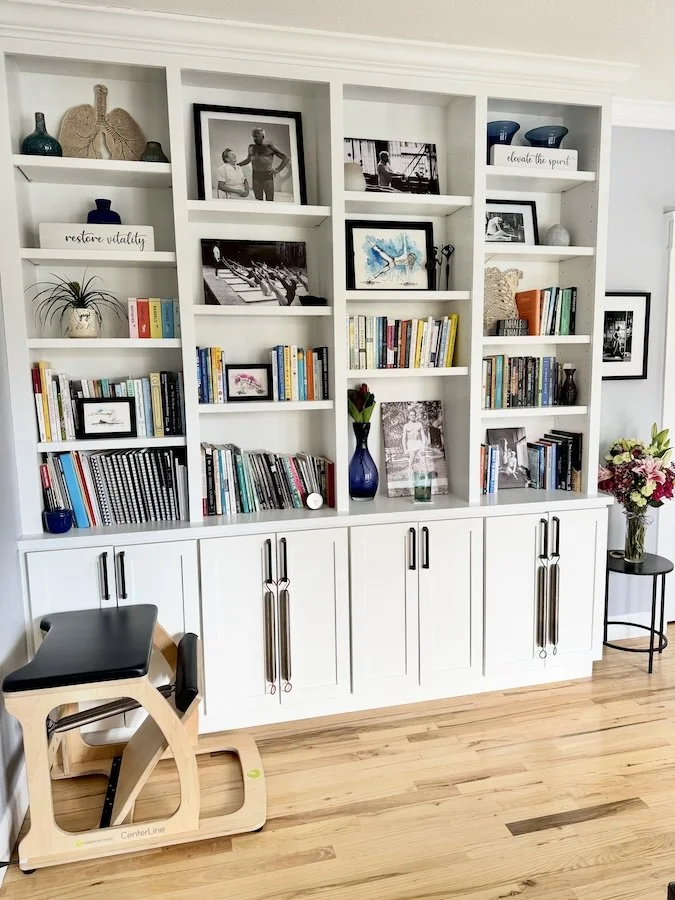
I am a huge reader. In fact, my Pilates studio features a bookshelf highlighting many of my favorite books on health. That’s why when Huberman finally published a book, I was so excited to read it. I prefer learning from books than podcasts.
What’s fascinating to me is that Huberman spends a large portion of the book talking about many of the things that I’ve been teaching for years as well—the importance of our light, sleep, and mindset. It’s not just recommendations on the usual diet, exercise, and supplements, although there is that too. He’s willing to broach subjects that aren’t really mainstream yet and I’m grateful that he’s lending his popularity to a worthwhile cause. Because he’s got a few things going for him that a simple Pilates teacher and health coach do not—he finished his Ph.D. in Neuroscience (while I mastered out… more on that shortly), he’s a MAN, and he works at a prestigious institution. So if Huberman says light matters, then it must!
I started my own Ph.D. in Neuroscience a few years after Huberman started his. And at the time, I didn’t understand what was going on, but now looking back, I see it so clearly. In graduate school, I felt awful. It wasn’t just because I was no longer one of the smartest people in the room. It’s because for the first time in my life, I struggled with insomnia. I gained weight and despite working out six days a week, couldn’t lose it. I felt like my mind was not doing what I expected. In retrospect, I suspect much of that had to do with poor lighting and the resulting circadian disruption and mitochondrial impairment. In undergrad, I studied in Malibu at Pepperdine University and spent significant time outside each day. In graduate school at the Health Sciences Center** in Denver, Colorado, I was lucky if I got 10 minutes of sunlight total each day, and that was just from walking to and from my parked car with sunglasses on (which basically negates any benefit). Classes, lab, and my break room for lunch were windowless. I was surrounded by artificial light all day long. My brain and body were starved from the essential nutrient that is sunlight and thrown into physiological chaos with the mixed signals it was getting.
Now I understand why poor lighting was so detrimental to my mind, sleep, weight, and health, but it took me twenty years to figure it out. Lack of proper light signals and the fact that I really struggled with decapitating three rats per day for my experiments—how else do you think the components of the brain get studied??—and not interacting with humans as much as I would have liked led me to master out of the program. It is ironic to me that in order to study the brain, I was asked to sacrifice many of the tenets required for a healthy brain (sunlight, sleep, stress reduction, and socialization). I chose my health over my Ph.D., and I’ve been prioritizing it ever since. But just because I am not Dr. Briegleb doesn’t mean that my curiosity and drive to seek knowledge ever faded…
For years, I’ve been studying light. So to see that the very first three protocols in Huberman’s book discuss light, and to see that one out of seven chapters exclusively covers light, is very exciting. Let’s examine what Huberman is recommending.
For Good Sleep, Focus on Light
Huberman’s first chapter in his book covers sleep. I love this! Without proper sleep, we cannot repair and regenerate, nor solidify memories and the information we tried to learn that day. In a society that’s all about doing and often sacrificing sleep to get more done, it’s important that he’s emphasizing it. He says “Put simply, sleep is the foundation of our mental health, our physical health, and our performance.” I look forward to the day when medical school and graduate school in the sciences accepts, embraces, and supports that concept.
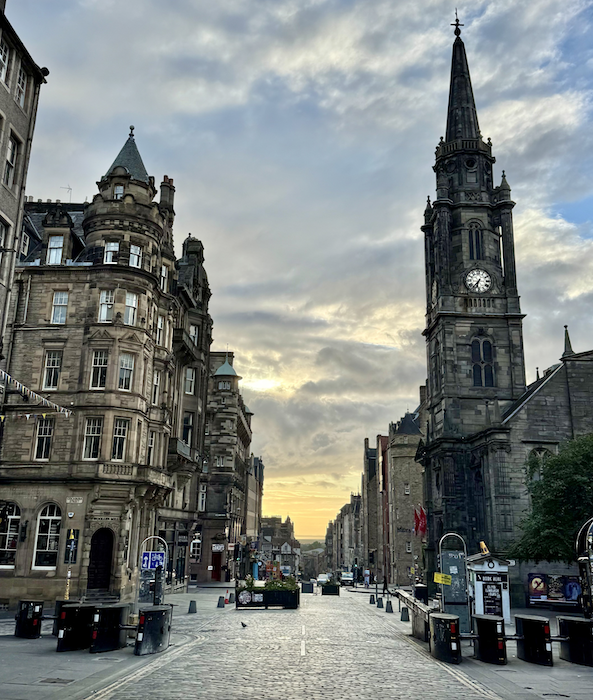
Sunrise on the Royal Mile in Edinburgh, Scotland. This street is normally packed but the Scots and their tourists clearly don’t appreciate the importance of morning light, as my husband and I were almost the only people awake and outside.
Huberman states that nearly half of adults report their sleep satisfaction as an F and at least a third of Americans do not get enough sleep. I believe a huge reason why we struggle so much with sleep is that very few people are aware of how much light affects their circadian rhythms and sleep. His very first protocol is to “get morning sunlight in your eyes as soon as possible after waking.” He recommends 5-10 minutes. This helps clear out melatonin from the night before that could make your groggy, stimulates the release of cortisol that gives you energy for the day, and helps your body understand that in 14-16 hours, you’ll likely be wanting to go to sleep again. This sunlight should be viewed without sunglasses or through window glass. You need to get outside.
I do many things to support my sleep, but last summer while on vacation in Scotland, I was unable to do many of them (like ground while sleeping or finish my last meal 4 hours before bedtime). However, I was able to get up in the morning and get sunlight into my eyes. I was impressed by how much that alone supported my sleep.
“Morning sunlight viewing is the best way to increase our morning and daytime energy levels.”
His number two sleep protocol is to book end the day by getting more sunlight in your eyes, ideally 10-15 minutes, close to when it sets. This reduces the sensitivity of your eyes to the artificial light you see after sunset, which is highly disruptive to your melatonin production and sleep. Here, Huberman and I differ. He wants you to get this healthy natural light so that you can handle unhealthy light later. Perhaps this easy to achieve recommendation is what the general public needs. However, at Optimize, I coach avoiding that unhealthy light after sunset all together. I suggest seeing the sunset because the eyes and brain actually can detect the spectral composition of sunlight and understand that even though the sun is just sun to your conscious mind, that the day is ending because of what wavelengths of light are present. And then your brain understands that so long as you don’t flood it with blue light after sunset, maximal melatonin will be released in a few hours to ensure a great night’s rest and proper brain cleaning.
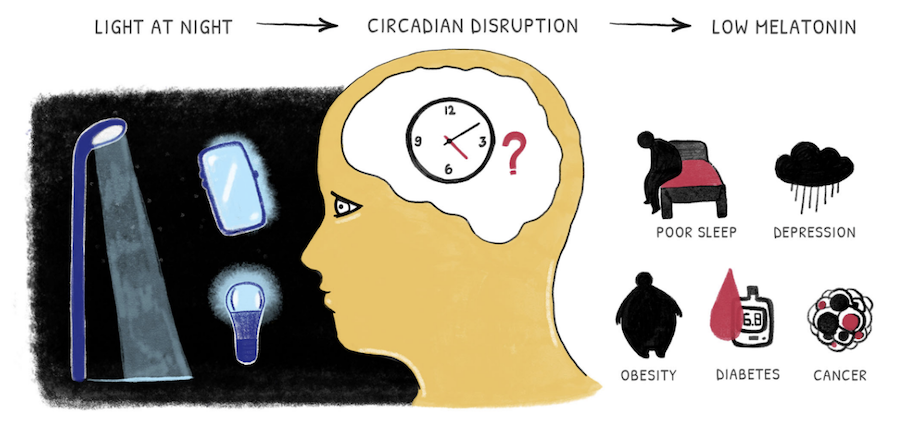
The consequences of light at night. Image created by Kris Lankovska, former Optimize client.
Protocol #3 for sleep is to “avoid viewing bright lights in the final hour before bedtime.” He recommends limiting nighttime light exposure after sunset by dimming the lights, using red lights, using candlelight, or wearing blue light blocking glasses. I am so pleased that he’s willing to say this, because it sure is inconvenient for our culture! We don’t want to be bound by nature, especially not this time of year when daylight is only for 8-10 hours. Many of us like brightly lit houses in the evening and time to work on our computers, or time to decompress in front of the TV or phone. And while it seems weird to have red light bulbs at your house (my neighbors have been asking what’s going on for years, and friends that come over for dinner sometimes tease me), who cares what other people think if you’re relaxed, calm, and sleeping great. Funny enough, I started writing a book very similar to Huberman’s at the beginning of this year and my first chapter was entirely on the importance of circadian rhythms and the dangers of light at night (LAN). The correlation between LAN and cancer is shocking. Oddly, Huberman doesn’t mention that once, even though in his introduction he lamented one of his greatest mentors dying of breast cancer at age fifty. I will share a few notable facts and studies here, because cancer is the second leading killer after heart disease and if your light environment affects that, I think you should know. I focus primarily on breast cancer, where the research of effects of LAN is the strongest, and because it is the leading form of cancer for women, with more women affected than from the next four common cancers combined (source).
In 2007, The World Health Organization's International Agency for Research on Cancer (IARC) determined that shift work, which clearly involves artificial light at night, is a probable carcinogen (source).
In 2021, the U.S. National Toxicology Program (NTP) also concluded with a moderate level of confidence that there was a causal relationship between certain lighting conditions, in particular light at night coupled with insufficient daylight exposure, and human cancer (source).
A 2021 meta-analysis examined 17 studies, including ten cohort and seven case controlled studies, and found an 11-14% increase in risk of breast cancer in the subjects with the most LAN compared to those with the least (source).
Another 2021 meta-analysis of 24 studies found outdoor LAN exposure was consistently associated with about a 12% increase in breast cancer risk, with indoor LAN showing a 13% increase (source).
The risk from light at night is similar to the risk of breast cancer from light drinking (source), smoking (source), or not exercising (source).
Light at night (LAN) has also been found to correlate with prostate cancer, obesity, diabetes, and depression. It is a serious risk, made worse by our recent lighting developments (LEDs replacing incandescent bulbs, bigger and brighter LEDs on everything from street lights to headlights, etc.) Given the prevalence of the research on this topic, I was surprised that a scientist wouldn’t explain more of the science of how light at night is a considerable risk to our overall health and not just to our sleep.
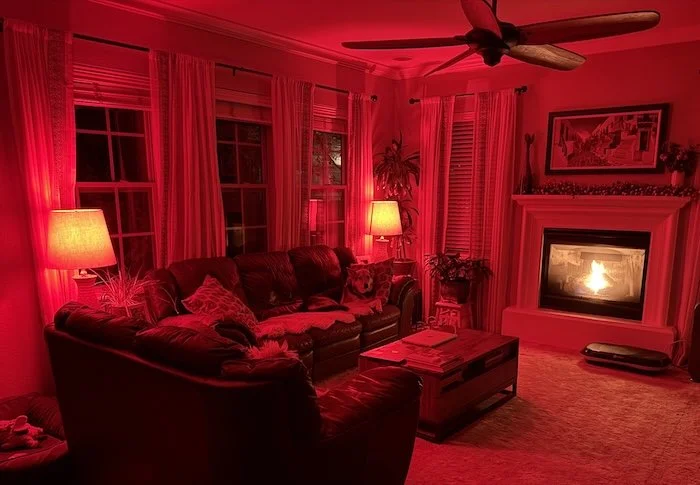
The lighting in my living room at 6:30pm in the winter. My dog benefits from good circadian rhythms too!
Unlike Protocol #3, I don’t believe that cleaning up your light in just one hour before bedtime is ideal. I recommend doing it for the entire evening. After you see the sunset, I recommend avoiding blue light into your eyes. You might consider orange bulbs in your living spaces (which lack blue but contain green, another short wavelength light that does have affects on melatonin and sleep for more sensitive individuals). I actually use red light bulbs in my living room, bathroom, and bedroom. If I watch TV, use a computer, or go out of my house in the evenings, I wear blue light blocking glasses. If you have a social event or special dinner out, you don’t need to be so strict. But if you can do this the majority of evenings, you will come to love it. My home feels so calm and relaxing and cozy in the evenings. And I bring similar lighting when I travel so my hotel rooms can be that way too. Thank you Huberman for helping make this strategy more mainstream, but I still think his recommendation is a tad minimal. If the science shows that blue light tells the SCN it’s time to be awake, then why tell people that it’s okay at 8:30pm if they want to go to bed by 10:00pm?
“You’ll be happy to know I stopped looking at my phone in bed at night. I figured I might want to listen to some of your good advice. And yes, I’m sleeping better.”
Before we jump to his chapter on light, I want to briefly acknowledge how great it is that he has a chapter on stress control where he talks about how breathing techniques and sessions similar to mini meditation (he teaches what he calls Non-Sleep Deep Rest, I’m a huge fan of HeartMath) are important. We don’t have a society that really builds in the supports to offset stress, so I’m happy to see more and more teachers and coaches giving people strategies to help. This is why 15-minutes of every lesson at Optimize are dedicated to nervous system decompression.
A Whole Chapter on Light
Chapter five lists five protocols for light, and three of them are reiterating what we just covered from the sleep chapter. See morning sunlight near sunrise (or whenever you wake up, according to Huberman), see sunlight near sunset, and avoid artificial light before bed. Thankfully, he takes time now to also teach the importance of sunlight during the middle of the day, in a protocol oddly titled “Expose Your Upper and Lower Body Skin to Sunlight During the Day.” Upper and lower body? As in, your body? How about Expose Your Skin to Sunlight During the Day?
“Getting sunlight on our skin is as much a cortnerstone of health as sleep, exercise, and nutrition.”
He mentions the one and only thing that the mainstream agrees is worthwhile about midday sun—its UVB rays help you make vitamin D. But UV light does so much more than that! He points out that it reduces pain. It also helps you make hormones and neurotransmitters, as well as endorphins (which is part of how it reduces pain). I especially love the study that he’s cited on his podcast before and now includes in his book, which suggests that UVB elevates the hormones of rats, changes their scents, and makes them more attractive to potential mates. Don’t worry—this hasn’t been only found in rats. He cites a 2021 human study as well, which found higher testosterone in both men and women after time in the sun. Evidently sun makes you sexy!
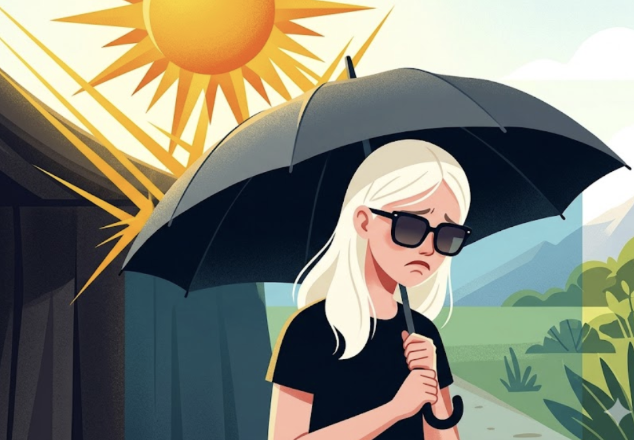
A Swedish study of 30,000 women found that sun avoidance had the same risk on mortality as smoking!
He then mentions one of my all time favorite studies, the good old 2011 Swedish, 30,000 women study that found that people who spent the least time in the sun had double the mortality risk of those who spent the most time in the sun. He failed to include the best part in my opinion, where the authors of that study found that women who actively tried to spend time in the sun but smoked had a similar mortality rate to sun avoiders who didn’t smoke. So sun avoidance is as dangerous as smoking? Interesting.
He is a partial owner of a mineral sunscreen company. I wish as a neuroscientist he would have discussed nanoparticles, which is how some sunscreen manufacturers have tried to make white and pasty zinc oxide more translucent when covering the skin. While this makes zinc oxide products more pleasing to use, research shows that nano particles can cross the blood brain barrier and are neurotoxic (source, another source, and yet another source).
Clearly Huberman is from California because there is no mention of what to do if you live where it is too cold to expose your “upper and lower body” skin to sunlight. Or what to do if you live at a latitude where no UVB penetrates the atmosphere for months every year. The topic of sun and light is massive, so he started a decent introduction. But there’s still a lot unanswered despite his 600+ page book. Perhaps there is still a market for the book I had started to write…
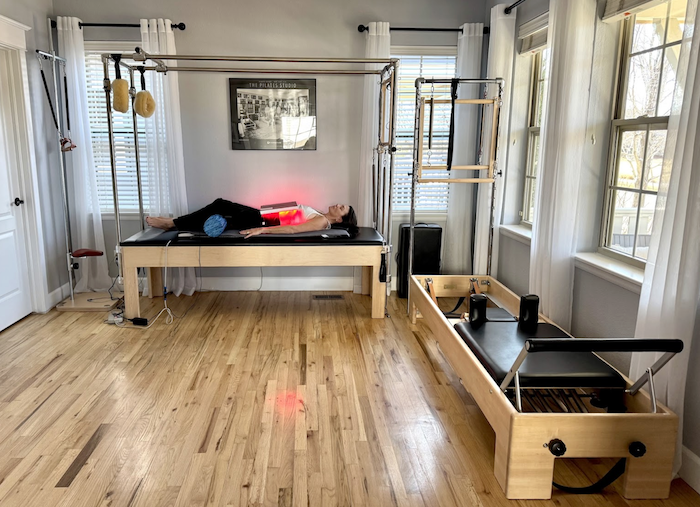
After your Pilates lesson, Optimize sessions end with modalities to decompress you. This client is laying on a heated PEMF mat and grounding while also using a red and infrared light panel.
The final light protocol is to use a “long wavelength light emitting device for 10-30 minutes, 3-7 days per week.” Huberman suggests get the red and infrared light our mitochondria need via a modern device. That’s fine, except that the red light panels I use at Optimize cost $400-$1000+. And almost half the sun’s rays are red and infrared, at all times of the day. So you can get that for free just by being outside. And yes, the infrared penetrates through your tissues as well as through light clothing and hats. I really think the best recommendation is to just get outside more. We all have access to the sun’s gifts for free, and no manmade light with a handful of light wavelengths can replace the sun that emits literally every red and infrared wavelength (from 600 to 1,000,000nm, although my scientist father wants me to say that water vapor in the air limits that to about 3000nm—still, a lot more wavelengths than offered by any device. )
Thank you Andrew Huberman for recommending almost four dozen protocols, which makes my recommendations seem reasonable by comparison. I appreciate you writing a book, and a popular one, that I can recommend to the skeptics who don’t understand why sunglasses are a problem and why a red light bulb can improve your life.
**By the way, the windowless labs I worked in during graduate school have been torn down and an entirely new graduate and medical school campus for the University of Colorado Anschutz opened in 2021. My primary investigator in graduate school passed away in her 60s of brain cancer.
If you enjoyed this blog post, see Dear Dermatologist too.