

Why Pilates is the Best
I grew up loving exercise. I’ve tried a lot of different ways to stay in shape. I only came to Pilates because my body hurt and wouldn’t tolerate high impact exercise anymore.
When I first tried a Pilates mat class in 2012, I didn’t even think of it as exercise. I wasn’t sweaty. It didn’t seem hard. I would go to the gym and lift weights or take a Zumba-style class before mat class, or else I didn’t think it counted as a workout. And that was where my mind was at—I needed to get a “workout.”
Funny how much things can change.
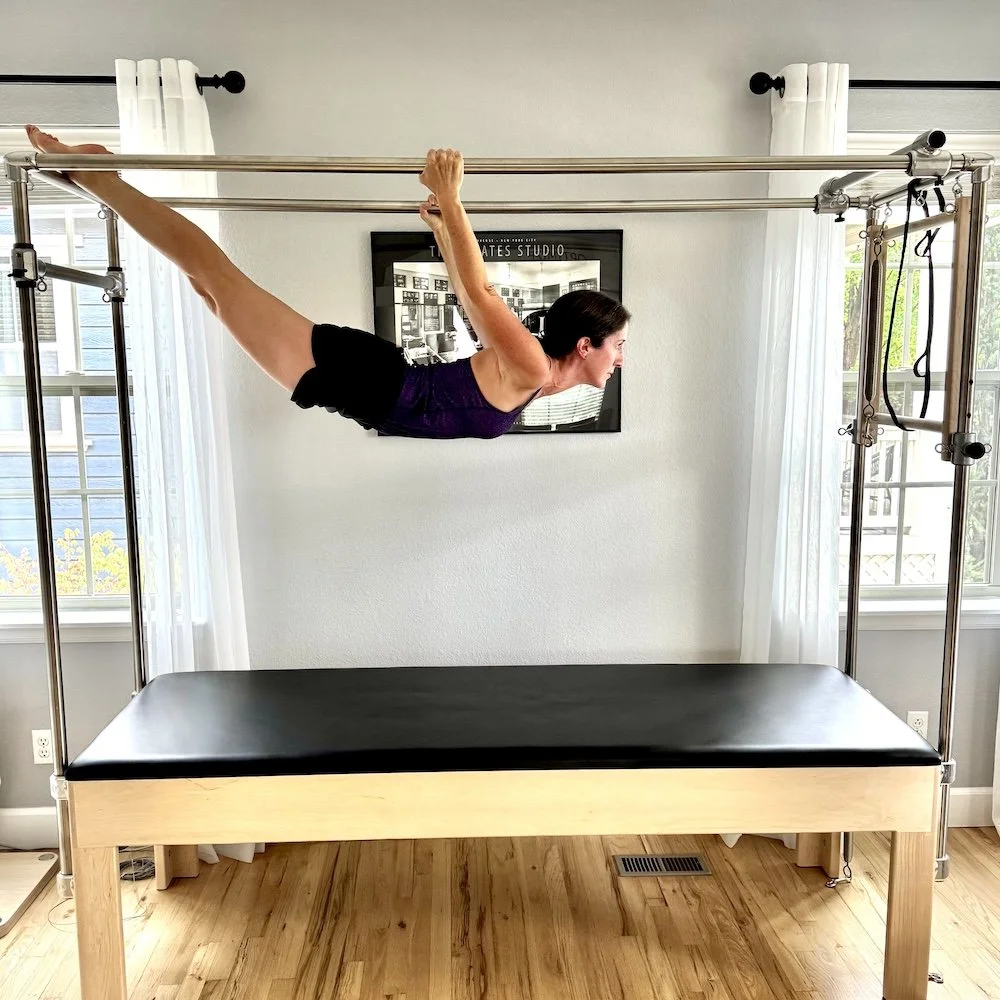
Pilates makes you feel like you can fly… it is that empowering!
It’s now been a dozen years since I started doing equipment Pilates regularly. For the first year, it was in conjunction with my regular gym rat behavior (lots of lifting weights and group fitness classes). For the next eleven, it became my main form of exercise.
And here’s the interesting part. I feel more fit through Pilates alone, more flexible, less vulnerable to injury, and practically no pain in my body despite growing older. That’s in stark contrast to how I felt when I was in the gym six days a week. The simple truth is that Pilates gave me better results with more enjoyment than traditional training.
The other thing Pilates did was nurture my mind. And not just my mind-body connection. But my attitude towards my body. It wasn’t something to whip into shape. Exercise wasn’t to sculpt a particular form. I stopped calling my movement a workout, and even stopped thinking of it as exercise. It just became movement. Movement that felt good. Movement that I craved. Movement that I did because I wanted to, not because I felt like I had to.
Here are fourteen reasons, one for each year I’ve been doing it, why I think Pilates is the best movement practice for the body:
It’s tried and true. The classical Pilates method has been around for about 100 years and is still growing in popularity. This is because it is potent and powerful!
It’s creative. There are over a dozen pieces of equipment and hundred of exercises. In the hands of the right teacher, you’ll never get bored. It’s endlessly stimulating and rich in promoting growth and change.
It’s gentle on the body. This doesn’t mean it can’t change you. Quite the opposite. Because it works with your mind and gently approaches the body, I think more significant change can result. You can also get enormous gains without pain. I’m in awe of how strong I have gotten with Pilates and without the usual soreness that typically follows hard workouts.
It changes your movement patterns. Normally, exercise is only concerned with whether or not you can do something. Pilates is concerned with how. It changes the way your brain controls movement. It is brain and body exercise!
It aligns you. True Pilates teachers are concerned with alignment and will correct yours in lessons. It’s like physical therapy meets exercise. And the result is that your joints feel better, you have better muscular balance, your posture is more youthful, and you prevent injury.
It’s mindful. You have to think in Pilates! You have to control strange patterns you weren’t even aware of before. You have to be coordinated. You have to be patient and persistent. Exercise is more effective when the mind works with the body, as opposed to trying to distract it with TV, phones, magazine articles, loud music, or a coach yelling at you.
It trains strength and flexibility simultaneously. Instead of stretching at the end of your workout, Pilates incorporates big ranges of motion into the strengthening movements. This is so much more effective as well as functional. My flexibility was poor my whole life until I committed to Pilates.
It doesn’t drain body resources. The way some people like to train their bodies is really hard on them. So many people still believe “no pain, no gain.” But when you break down your muscles with high intensity and/or repitition, your immune system has to dedicate all resources to muscular repair. I believe this can compromise your immunity. I get a lot less sick from doing Pilates regularly. It makes you stronger without such intense breaking down of the body first.
It trains the body uniformly. Traditional training focuses on favorite muscles—abs, glutes, quads, pecs. Pilates trains all your muscles for more uniform development. Nothing is neglected. Not in the intrinsic foot muscles, not your piriformis, not your rotator cuff, not your wrist, not your neck. You are only as strong as your weakest link. Big huge lats and pecs don’t work for you if you damage the supporting rotator cuff. Because Pilates works all your muscles large and small, you are less prone to injury.
It prepares you for the unexpected. Working out on unstable equipment that demands quick responses trains your nervous system for how to react to trips, falls, or loss of balance. It trains your cerebellum, which coordinates movement and controls balance, and that is super useful in the everyday world. I can’t tell you how many clients think Pilates has saved them from an injury.
It strengthens the feet. I sprained my ankle badly when I was a teenager, and was prone to ankle sprains after that. At age 18, I decided that barefoot exercise would strengthen my feet to stop that problem (which I did through Tae Kwon Do , Tae Bo, and kickboxing). And it was true! I’ve never sprained an ankle again. I believe that Pilates takes that another step. It’s not just executed barefoot, but the exercises are specifically designed to strengthen and align the foot and ankle. Barefoot is absolutely best!
It’s adaptable. No matter what stage of life you’re in—deconditioned, athlete, pregnant, postnatal, elderly, injured—it can be adapted and modified to meet your needs. There aren’t many fitness routines that will grow with you for decades.
It’s like a moving meditation. Classical Pilates is choreographed to the rhythm of the breath. If you really truly get into the flow that Joseph Pilates intended, with your focus on your inhale to open the spring and exhale to close the spring, you will get phenomenal physical exercise while your mind is functioning in a meditative state. All that means is that the brain is in slower brain waves, which is very restorative to the body. You have to be in this state to heal. If you get your Pilates practice to the level where you can flow in this way, it is so powerful. Sadly, this is not how Pilates is really done or taught today. There is a lot of talking, analyzing, and correcting. But Joe’s studio did not allow for talking. Just more focus on yourself and the animal movement of your body and breathing.
It gets to the root of what you need for good health. It strengthens the breathing mechanism, it trains the core muscles that support the organs and back, it moves lymph and helps the body get rid of waste, it improves circulation to every cell in your body, it improves the flexibility and strength of the spine (not only the main connection between brain and body, but the center channel of energy flow in Ayurvedic medicine), it focuses the mind—to name a few. It is so much more than exercise. It truly is a whole body, whole health method.
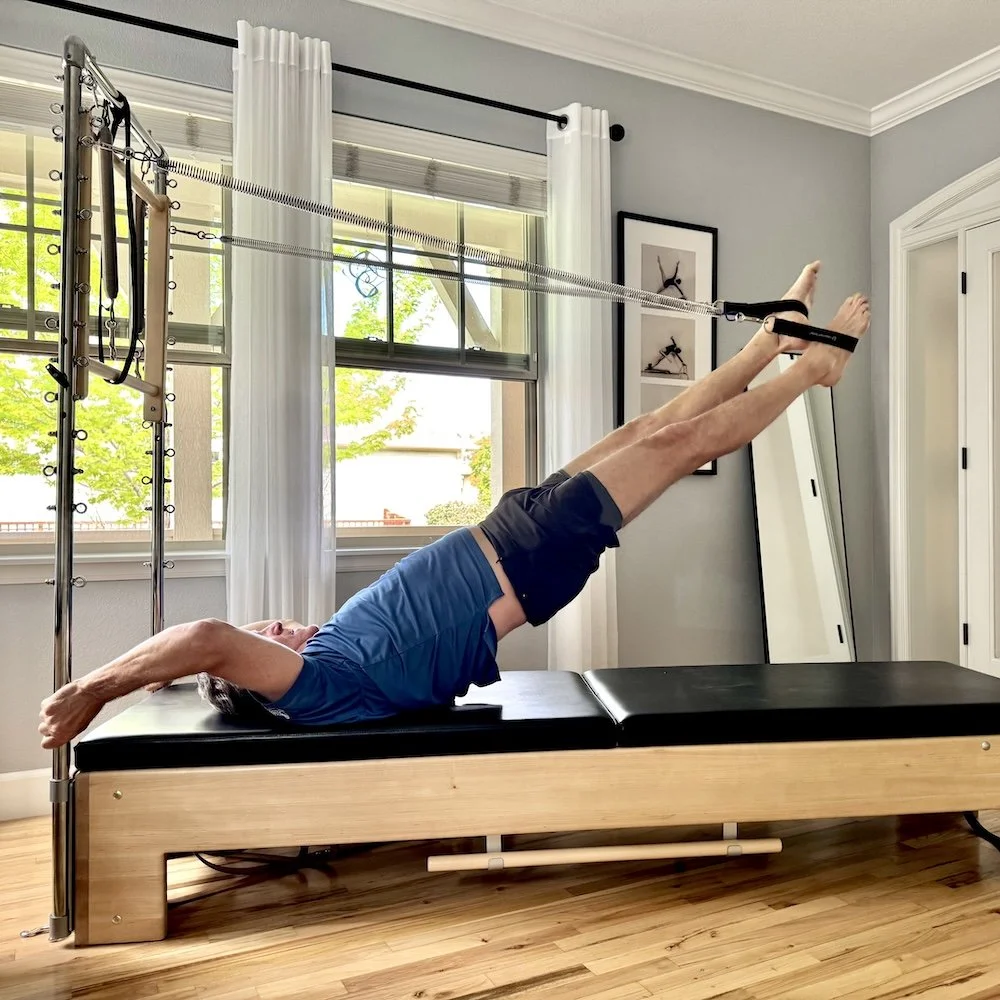
Pilates never gets boring. This gentleman has been taking weekly lessons for over eight years.
I hear some people, perimenopausal women in particular, say that they need more strength training than Pilates provides. To that I would say that you need to push into the next level of Pilates or use some smart adjustments to the method to achieve your desired results. Your body weight is excellent resistance and if you can do the advanced work of Pilates—with pushups, pullups, planks, side planks, and squats,—you will develop great muscular strength and bone density. Adjustments to springs or stacking of similar exercises back to back can help you achieve goals of strength or endurance easily. Now I do personally use weights periodically, but I still think of them as a supplement to Pilates, not sufficient alone. Even pictures of Joseph Pilates’ studio show barbells.
If you’d like to try Pilates, here is what I recommend you do. See if you can find a well trained teacher. Ideally the teacher has done over 600 hours of training and is Nationally Certified, which means s/he has sat for a qualifying exam regardless of what training program they went through. This also means the teacher has to stay up to date on continuing education. Try to find a teacher who has her own personal Pilates practice. The best teachers are students themselves, doing and practicing the work regularly. If none are available, there are online options through Pilates Anytime or Pilatesology. You could also buy the book Return to Life and start teaching yourself the mat work with Joe’s images and instructions from 1945. This video I created nine years ago features ten of Joe’s mat exercises that you could try. But the experience of working in person with a good teacher is priceless. And then even if you do find a good teacher, I recommend that you practice on your own as well. You will improve exponentially when you take personal responsibility for your practice and alignment.
I’ve seen hundreds of bodies changed by Pilates. And I’ve seen what it’s done for me personally. I can say with confidence that I truly believe it to be one of the most powerful methods of movement. It’s okay if you don’t immediately fall in love with it I didn’t in 2012. But I was intrigued and like a moth to a flame, I kept returning to it in different ways. Finally in 2016, I was in love, and that attitude hasn’t changed in a decade.
Try it for yourself and see!